Books

old crow
and crooked tree
While Jackie’s sister was cleaning her attic full of old toys, she came
across a large hand puppet made to look like a disheveled crow and
gave it to Jackie. His beak had a squeaker in it so, when operating the
puppet, it squawked like a real crow. The fanciful puppet made Jackie’s
granddaughter laugh, and it was one of her favorite toys to play and
interact with when visiting Jackie.
After moving to a new house where the back yard bordered on a working farm with vast fields of corn and wheat, her husband noticed a dead tree apart from the other trees in the field and remarked that it was his favorite. “That tree might not be there for long. It’s dead,” Jackie told him. But it stood out from the others and created an interesting silhouette against the hill rising behind it.
Crows would sit on the branches, but they weren’t happy to just look around. They seemed to battle for the top-most tip of the highest branch. One particular crow would take charge and sit there looking down, squawking at the others and remaining at its perch for long periods of time. One by one, the others would fly off into the field or the trees that lined the fields. The last crow to leave usually was the one at the very top of the highest branch. The favorite tree eventually became “Crooked Tree,” the focal point of Jackie’s first book.
Jackie believed that her main character, “Old Crow,” leader of the horde, was perfectly represented by the hand puppet. She also believed that there was another crow who deserved to have his story told. That crow became known as “Young Crow” in the series.
Both “Old Crow and Crooked Tree” and “Young Crow Gets to the Top” tell stories with subtle messages. It is Jackie’s hope that lessons about various virtues will be absorbed by readers (or young listeners) and applied in conjunction with the process of developing social skills as they journey through life.
“A Pony in Old Crow’s World,” the third book of the series, is close to Jackie’s heart. She wrote about it because children who care for animals need to learn how to communicate in non-verbal ways to gain trust and show discipline. She has never forgotten the lessons she learned from caring for horses, ponies and other animals she had the privilege to know and love.
Jackie believes that her interaction with animals helped the animals learn to trust her and other humans. And she knows that those animals taught her lessons she could never have learned without their presence in her life
After moving to a new house where the back yard bordered on a working farm with vast fields of corn and wheat, her husband noticed a dead tree apart from the other trees in the field and remarked that it was his favorite. “That tree might not be there for long. It’s dead,” Jackie told him. But it stood out from the others and created an interesting silhouette against the hill rising behind it.
Crows would sit on the branches, but they weren’t happy to just look around. They seemed to battle for the top-most tip of the highest branch. One particular crow would take charge and sit there looking down, squawking at the others and remaining at its perch for long periods of time. One by one, the others would fly off into the field or the trees that lined the fields. The last crow to leave usually was the one at the very top of the highest branch. The favorite tree eventually became “Crooked Tree,” the focal point of Jackie’s first book.
Jackie believed that her main character, “Old Crow,” leader of the horde, was perfectly represented by the hand puppet. She also believed that there was another crow who deserved to have his story told. That crow became known as “Young Crow” in the series.
Both “Old Crow and Crooked Tree” and “Young Crow Gets to the Top” tell stories with subtle messages. It is Jackie’s hope that lessons about various virtues will be absorbed by readers (or young listeners) and applied in conjunction with the process of developing social skills as they journey through life.
“A Pony in Old Crow’s World,” the third book of the series, is close to Jackie’s heart. She wrote about it because children who care for animals need to learn how to communicate in non-verbal ways to gain trust and show discipline. She has never forgotten the lessons she learned from caring for horses, ponies and other animals she had the privilege to know and love.
Jackie believes that her interaction with animals helped the animals learn to trust her and other humans. And she knows that those animals taught her lessons she could never have learned without their presence in her life

young crow
gets to the top
I wanted to give the characters in this book personalities that reflect the quirkiness of crows and explore how they might react to certain events, such as changed circumstances. People learn and grow as they gain experience in response to change. Do crows do the same?
Two particular crows about whom I have written previously came to mind. One is the leader of his horde. The other is a
young crow who aspires to some day head a family group. In this book, when something changes that creates a conflict for one of the crows, he seeks to improve his situation by going on a quest which eventually leads him right back home.
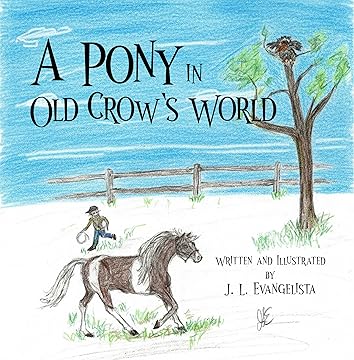
A PONy IN
OLD CROW'S WORLD
Jackie lives in an area surrounded by farms. Many are horse farms, some of which are owned by Amish farmers. On Sundays, she can always count on passing a horse-drawn buggy or two. Seeing the buggies reminded her of her childhood, when she drove a small cart pulled by her own pony named Cinnamon Stick. She decided to add a character based on Cinnamon Stick to this book, which is one of her many stories about crows. It involves the arrival of a pony on the farm where Old Crow and his group of crows live. Of course, this event is of special interest to the farmer’s son, who hopes to someday tame the pony, but it also presents a unique opportunity for Old Crow to learn more about leading his horde.